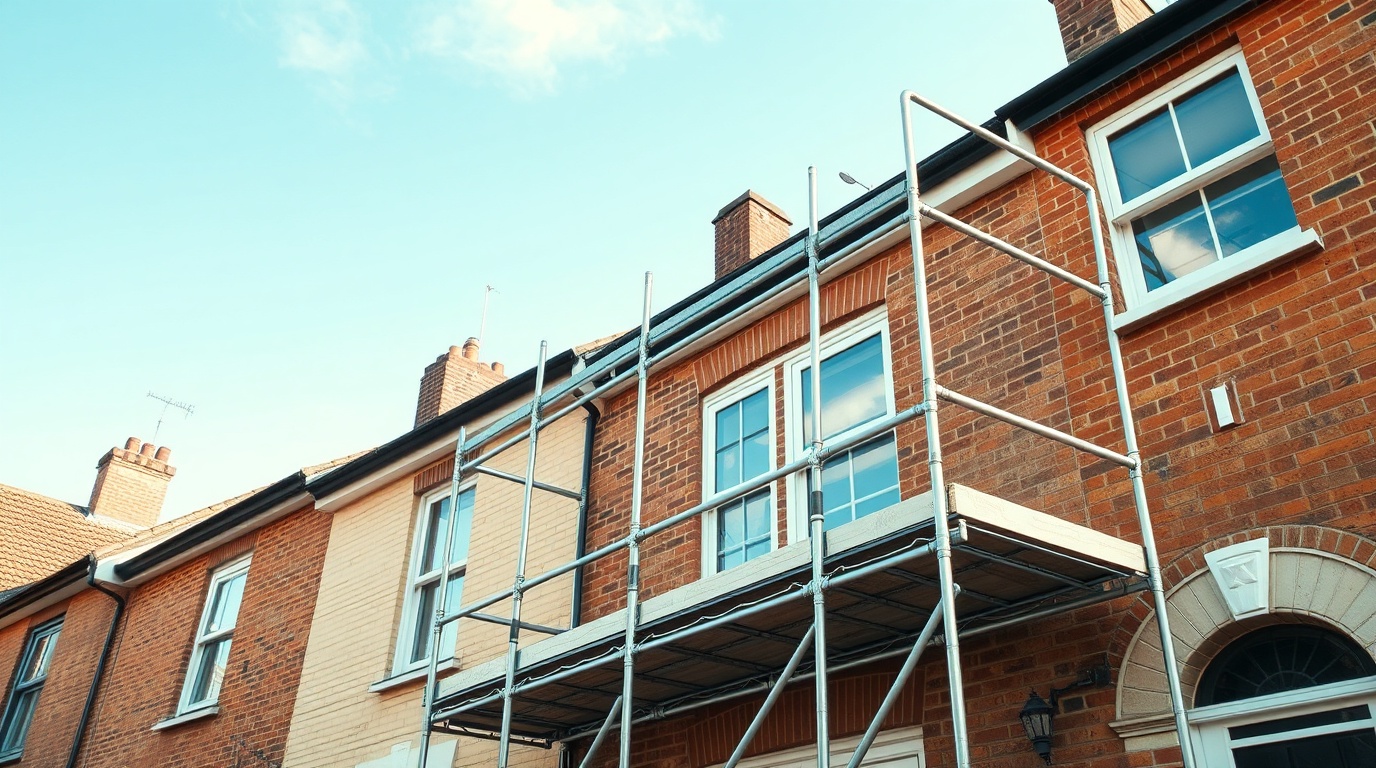
The short answer
A chimney scaffold's weekly cost follows the same model as any scaffold: a one-off erect-and-dismantle charge (the larger figure) plus a weekly hire fee after the included period, which is typically a small fraction of the upfront cost. What surprises people is that the upfront cost is often higher than the small platform around the chimney implies, because reaching a chimney usually means building a full scaffold up to roof level, then a chimney access platform at the top, sometimes with extra protection. The weekly fee scales with the size of that whole structure, not just the top platform. Height, the pitch and height of the roof, and how the scaffold reaches the stack all drive the price. Treat figures as indicative and dependent on the property.
A chimney scaffold looks small at the top, but the cost reflects everything needed to get there safely. Understanding that explains why the weekly — and upfront — figures are what they are.
Chimney scaffold weekly cost
- Pricing modelupfront charge + weekly fee
- Weekly feea fraction of the upfront cost
- What drives itthe full structure up to roof level
- Common surprisecost reflects access, not just the top platform
- Built byCISRS-trained scaffolders
Why a chimney scaffold costs more than it looks
The working platform around a chimney is small, so people expect a small price. The reality is that getting safely to the chimney is the expensive part. To reach a stack on a typical roof, scaffolders usually build a full scaffold from the ground up to eaves or roof level, then add a chimney access platform at the top so the roofer or sweep can work safely around the stack.
That means the cost reflects the whole structure — multiple lifts up the side of the house, the roof-level access, and any protection needed — not just the platform you can see at the top. The weekly hire fee then applies to that entire structure once the included period ends, so it is set by the full scaffold's size, not by the small top platform alone.
What drives the price
Several factors determine how much a chimney scaffold costs to build and hire:
- Roof height and storeys: a stack on a three-storey house needs far more scaffold to reach than one on a bungalow.
- Roof pitch and the chimney's position: a stack set back from the eaves, or on a steep roof, needs more structure and sometimes a crash deck or roof-edge protection.
- Access to the base: a clear, level frontage is quick; restricted side access, a conservatory or sloping ground all add complexity.
- Duration: a quick repoint or pot replacement is short, but a chimney rebuild keeps the scaffold up longer, adding weekly fees.
- Public-land licence: if the scaffold base stands on a pavement, the council licence adds cost.
Because these vary so much by property, a chimney scaffold is always priced from a site assessment rather than a fixed rate.
| Factor | Effect on cost | Why |
|---|---|---|
| Taller roof / more storeys | increases | more scaffold to reach the stack |
| Steep pitch / set-back stack | increases | extra access and protection |
| Restricted base access | increases | slower, more complex build |
| Longer job (e.g. rebuild) | more weekly fees | scaffold stands longer |
| Base on public land | adds licence fee | council permit required |
Indicative guidance only. A chimney scaffold is priced from the whole structure needed to reach the stack, not the top platform alone.
Safety and the right structure
Work on a chimney is work at height and falls under the Work at Height Regulations 2005. A proper chimney scaffold provides a stable working platform with guard rails and toe boards, and where there is a risk of falling materials or a fall across the roof, additional measures such as roof-edge protection or a crash deck may be needed. The structure should be built by CISRS-trained scaffolders to a recognised standard such as NASC TG20 good practice.
This is why a ladder is not an acceptable substitute for anything beyond the most trivial inspection. A chimney scaffold is not just access — it is the fall-protection system that lets a roofer, bricklayer or sweep work safely at height for the duration of the job. The cost reflects providing that safely, and cutting corners on the access structure is a genuine safety risk, not a saving.
Keeping the weekly cost down
As with any scaffold, the weekly fee is the part that keeps running, so the practical control is time on site. Chimney work varies a lot in duration — a pot replacement or a repoint may be a day or two, while a rebuild or a re-flaunching can take longer and span weather delays. Keeping the weekly cost down comes down to scheduling the work efficiently so the scaffold is only up while it is genuinely needed.
If other roof work is planned — a re-roof, ridge repairs or new flashings — it is often worth coordinating it with the chimney work so a single scaffold serves both, rather than paying to build access twice. Booking the dismantle promptly once the work finishes, and being mindful of any public-land licence expiry, completes the picture. The upfront cost of reaching the chimney is fixed by the property; the weekly element is what good scheduling keeps in check.
Frequently asked questions
Why is a chimney scaffold so expensive for such a small area?
Because the cost is in reaching the chimney safely, not the small platform at the top. Scaffolders usually build a full scaffold from the ground up to roof level, then add a chimney access platform. The weekly fee applies to that whole structure, so height and roof access drive the price more than the top platform.
How does the weekly fee work for a chimney scaffold?
The same as any scaffold: a one-off erect-and-dismantle charge, often with an included period of several weeks, then a weekly hire fee afterwards. The weekly fee is a small fraction of the upfront cost and scales with the size of the full structure needed to reach the stack.
Can I use a ladder instead of a chimney scaffold?
For real work on a chimney, no. Chimney work is work at height under the Work at Height Regulations 2005 and needs a stable platform with guard rails, sometimes with roof-edge protection or a crash deck. A scaffold is the fall-protection system that lets the work be done safely, which a ladder cannot provide.
Sources & further reading
- HSE — work at height
- NASC — TG20 good practice guidance for tube and fitting scaffolds
- Checkatrade — scaffolding cost guide
Figures on this page are typical UK ranges drawn from published sources and depend on your specific job. They are guidance, not a quotation.